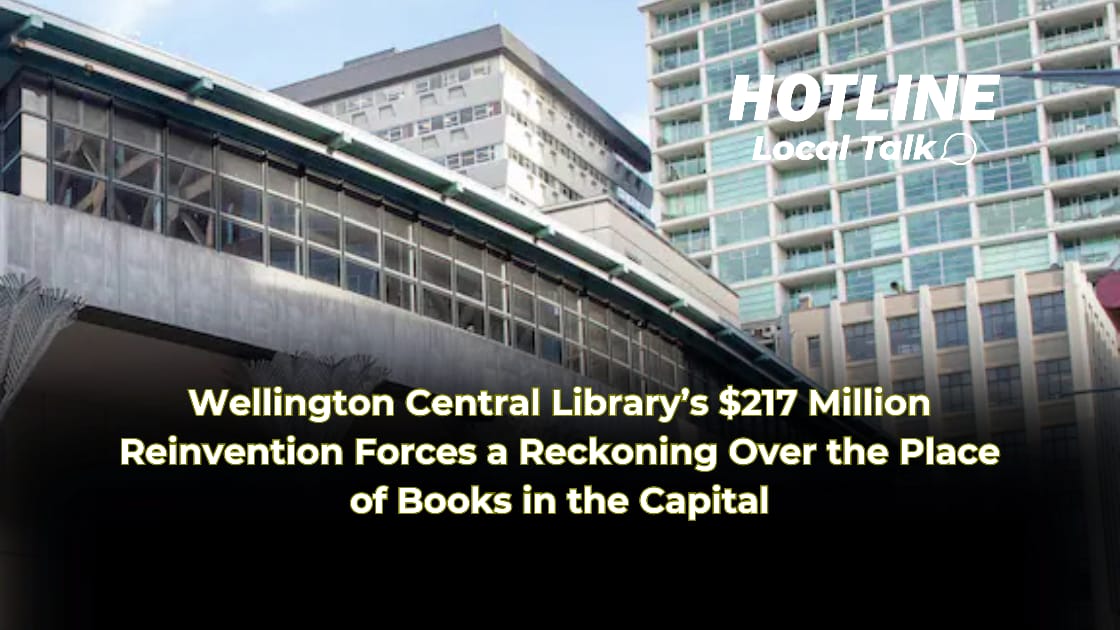
When Wellington Central Library reopens as Te Matapihi ki te Ao Nui, it will stand as one of the most expensive civic projects in the city’s history. At $217 million, the rebuilt library on Civic Square is being presented by Wellington City Council as a safer, stronger and more future-focused public space. Yet beneath the glass, steel and base isolators lies a quieter, more uncomfortable reality: the capital’s flagship library will reopen with around 80,000 fewer books on its shelves than it had before it closed.
The closure in March 2019 was sudden and unsettling. Engineers advised the building, opened in 1991, would not perform adequately in a major earthquake, and Wellington lost its central library overnight. For a city already grappling with seismic risk and ageing infrastructure, the shutdown became a symbol of wider civic fragility. Years of debate followed, with options ranging from demolition to rebuild. Ultimately, the council chose refurbishment and seismic strengthening, a decision framed as both financially prudent and culturally responsible.
The result is Te Matapihi, a reimagined Wellington Central Library designed not only as a place to read, but as a multi-purpose civic hub. Alongside traditional library services, the building will host a council service centre, Capital E creative spaces for children, city archives, exhibition areas and community venues. Officials say this integrated approach reflects how people now use public buildings and ensures the library remains relevant in a digital age.
It is within this redesign that the controversy sits. To make room for these additional functions, shelf space has been reduced. Roughly 80,000 books that were once immediately accessible will no longer be browsable on site. The council is careful to say the books have not been destroyed. Many are stored off site at Te Pātaka in Johnsonville and can be requested. From a logistical standpoint, the collection still exists. From a public experience perspective, however, it is fundamentally altered.
For regular users of the Wellington Central Library, the loss is not academic. Libraries are not just warehouses of information; they are places of discovery. Browsing matters. Serendipity matters. A book pulled from a shelf because its title caught the eye cannot be replicated by an online request form. Reducing the visible collection changes how people interact with knowledge, particularly students, researchers and readers who rely on physical access rather than digital subscriptions.
There is also a deeper question about priorities. Wellington is a city that trades heavily on its identity as creative, literary and intellectually engaged. Investing $217 million in a central library renovation while shrinking its core offering appears, to some, like a contradiction. Supporters argue that modern libraries must evolve, offering flexible spaces, digital resources and community programmes to survive. Critics counter that evolution should not come at the expense of the very thing that defines a library.
Wellington City Council has framed the changes as practical and forward-looking. Wider aisles, improved accessibility, better seismic performance and diversified services are all genuine gains. Few would argue against making the building safer or more inclusive. The concern is whether the pendulum has swung too far, turning Wellington Central Library into a civic centre with books, rather than a library first and foremost.
As the reopening approaches, expected in 2026, Te Matapihi will undoubtedly draw crowds. It will be new, impressive and heavily used. But usage alone does not settle the debate. What matters is how Wellingtonians feel once the novelty fades. Will the library still function as the city’s intellectual anchor, or will it feel like another polished public facility where books are present but no longer central?
The true test of Te Matapihi will not be its architecture or its earthquake rating. It will be whether, in the heart of Civic Square, Wellington has rebuilt a library worthy of its name, or quietly redefined what a central library is allowed to be.